

Combat Age-Related Fatigue Naturally: 7 Science-Backed Strategies
Table of Contents
- Understanding Age-Related Fatigue and Its Root Causes
- Sleep Hygiene for Older Adults: The Foundation of Energy
- Best Exercises for Older Adults to Increase Energy
- Foods to Boost Energy for Seniors and Support Cellular Health
- Stress Management and Mindfulness for Sustained Vitality
- When to See a Doctor for Fatigue: Recognizing Serious Conditions
- Cellular Health and NAD+ Optimization for Long-Term Energy
- Conclusion
Last Updated: August 6, 2026
Understanding Age-Related Fatigue and Its Root Causes
Age-related fatigue stems from a complex interplay of physiological, behavioral, and sometimes medical factors. At Rejuven8 Pharmaceuticals, we recognize that combating age-related fatigue naturally requires understanding what's actually driving your energy decline, not just treating symptoms.
Your body's cellular machinery operates differently with age. NAD+ levels decline, mitochondria become less efficient, sleep quality deteriorates, chronic inflammation develops, and nutrient absorption changes. Most people blame age itself, but many of these changes respond to specific interventions. The key is targeting actual mechanisms, not generic "energy tips."
Common causes include sedentary behavior, chronic sleep disruption, underlying medical conditions like sleep apnea or thyroid dysfunction, medication side effects, nutritional deficiencies, stress accumulation, and declining cellular metabolism. The most overlooked cause is polypharmacy, the cumulative effect of multiple medications that can interact or deplete critical nutrients, creating fatigue you could modify.
Sleep Hygiene for Older Adults: The Foundation of Energy
Restorative sleep is non-negotiable for managing age-related fatigue. Sleep becomes harder to achieve with age as your circadian rhythm becomes less stable and sleep apnea becomes more common.
Sleep hygiene for older adults differs from younger populations. You need consistency more than flexibility. Your internal body clock becomes more rigid with age, so irregular sleep schedules hit harder. Start with these specific practices:
-
Set a fixed sleep schedule. Go to bed and wake at the same time, seven days a week. Most people see improvements within two weeks.
-
Create a cool, dark bedroom. Aim for 65-68°F. Use blackout curtains or an eye mask.
-
Eliminate light exposure in the evening. Stop screen use 60-90 minutes before bed or enable blue light filters.
-
Avoid caffeine after 2 PM. Caffeine's half-life is 5-6 hours; a 3 PM coffee still affects sleep at 8 PM.
-
Limit alcohol near bedtime. While it may help you fall asleep, it fragments sleep architecture and reduces deep sleep quality.
-
Address sleep apnea screening. If you snore, gasp during sleep, or wake unrefreshed despite 8 hours in bed, ask your doctor about sleep testing.
Poor sleep degrades cognitive function, impairs glucose regulation, and increases inflammation. One night of bad sleep elevates cortisol and inflammatory markers; weeks of poor sleep creates chronic fatigue that no supplement fully compensates for.
Best Exercises for Older Adults to Increase Energy
Exercise is one of the most potent fatigue-fighting interventions available. The paradox: exercise creates short-term fatigue but produces long-term energy. Consistent movement over weeks increases your baseline energy substantially.
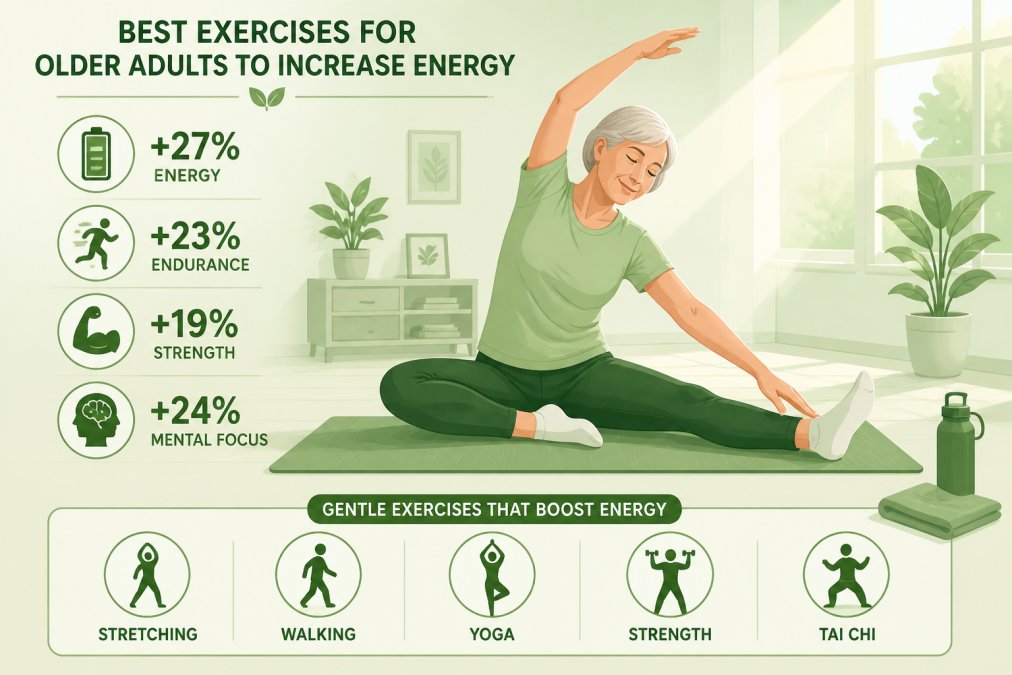
Physical activity combats age-related fatigue by improving mitochondrial function, enhancing oxygen use, increasing muscle mass, improving sleep quality, and reducing inflammation.
For most older adults, this protocol works:
-
Resistance training 2x per week. Use bodyweight exercises, resistance bands, or light dumbbells. Focus on compound movements: squats, push-ups, rows, overhead presses. Two sets of 8-12 repetitions per exercise. This preserves muscle mass, which directly contributes to fatigue when lost.
-
Walking or low-impact cardio 3-4x per week. 30-45 minutes at conversational pace. Consistent walking improves energy levels faster than high-intensity work for most older adults.
-
Flexibility and balance work 2-3x per week. Yoga, tai chi, or stretching routines maintain mobility and reduce injury risk.
-
One rest day per week. Recovery matters more as you age.
Morning exercise tends to improve sleep quality that night and boost energy throughout the day. Evening exercise within 3 hours of bedtime can disrupt sleep for some people.
Foods to Boost Energy for Seniors and Support Cellular Health
Nutrition directly affects energy production at the cellular level. Your cells generate ATP through metabolic pathways; the quality of fuel determines efficiency. Age-related fatigue often involves nutrient deficiencies that develop silently: iron absorption declines, B12 absorption becomes less efficient, and vitamin D synthesis decreases.

Focus on these food categories:
Protein-rich foods. Older adults need 1.0-1.2 grams per kilogram of body weight daily. Include eggs, fish, poultry, legumes, Greek yogurt, and nuts. Distribute 20-30 grams of protein across meals for optimal muscle synthesis.
Omega-3 rich foods. These support cellular health and reduce inflammation: fatty fish (salmon, mackerel, sardines), walnuts, flaxseeds, and chia seeds. Aim for 2-3 servings of fatty fish per week.
Colorful vegetables and fruits. Dark leafy greens contain iron and folate; berries provide antioxidants; orange vegetables provide beta-carotene. Variety matters.
Whole grains. These provide sustained energy through complex carbohydrates and B vitamins: oats, brown rice, quinoa, whole wheat bread.
Healthy fats. These support hormone production and cellular function: olive oil, avocados, nuts, and seeds.
Water. Dehydration is a massive fatigue driver. Older adults have a blunted thirst response, so drink consistently throughout the day. Aim for pale yellow urine as a hydration marker.
Avoid processed foods, excessive sugar, and excess alcohol.
Stress Management and Mindfulness for Sustained Vitality
Chronic stress is a fatigue multiplier. Stress hormones like cortisol are useful acutely but destructive when chronically elevated. They suppress immune function, impair sleep, increase inflammation, and deplete energy reserves.
Stress management requires deliberate practice. Mindfulness and meditation directly reduce stress hormones and improve sleep quality. Ten to fifteen minutes daily shows measurable effects. Start with simple deep breathing: inhale for 4 counts, hold for 4, exhale for 6. The longer exhale activates your parasympathetic nervous system. Do this three times in the morning and three times in the evening.
Structured relaxation time matters. Dedicate time to activities that refill you: reading, gardening, time with friends, creative pursuits. This isn't luxury; it's maintenance.
Identify and reduce unnecessary stressors. Audit your life: what can you reduce or eliminate? What boundaries do you need?
Chronic stress elevates cortisol, which impairs sleep, increases inflammation, and shifts metabolism. Managing stress reverses these patterns.
When to See a Doctor for Fatigue: Recognizing Serious Conditions
Not all fatigue is lifestyle-related. Some stems from medical conditions requiring diagnosis and treatment.
See a doctor if fatigue persists for more than two weeks despite adequate sleep, exercise, and nutrition; is new and represents a change from your baseline; accompanies other symptoms like unexplained weight loss, fever, shortness of breath, or chest pain; worsens despite lifestyle modifications; or you suspect medication side effects.
Common medical causes include hypothyroidism, anemia, sleep apnea, depression, COPD, heart disease, and diabetes. All are treatable. Your doctor will likely order blood work: complete blood count, metabolic panel, thyroid function tests, and vitamin D levels.
Be specific with your doctor. Describe when fatigue peaks, whether it's constant or episodic, whether it affects mental focus or physical energy, and what makes it better or worse. This detail helps narrow diagnosis.
Cellular Health and NAD+ Optimization for Long-Term Energy
The deepest layer of age-related fatigue involves cellular metabolism. Your cells generate energy through mitochondrial function, which requires NAD+ (nicotinamide adenine dinucleotide), a critical coenzyme that declines with age. NAD+ levels drop approximately 50% from age 20 to age 60.
Lower NAD+ means less efficient ATP production. Your cells work harder to generate the same energy. Supporting NAD+ production addresses this mechanism. Rejuven8 Pharmaceuticals' science-backed NMN formula is designed specifically for this. NMN (nicotinamide mononucleotide) is a direct NAD+ precursor that crosses the blood-brain barrier and converts to NAD+ inside your cells more efficiently than alternative approaches.
What does NAD+ optimization do? It enhances mitochondrial function, improves cellular repair mechanisms, supports metabolic health, and increases energy production. The result is more sustained energy, sharper mental focus, and better physical recovery.
This approach pairs with lifestyle changes. Exercise increases NAD+ demand, triggering adaptive responses that boost NAD+ production naturally. Sleep quality improves NAD+-dependent cellular repair. Nutrition provides substrates for NAD+ synthesis. Combined lifestyle optimization with targeted cellular support compounds effects.
Rejuven8 Pharmaceuticals' formulas are clinically validated.
Age-related fatigue doesn't require resignation. Sleep consistency, regular movement, nutrient-dense food, stress management, and when needed, medical evaluation address the actual mechanisms driving energy decline. For many people, these changes alone restore vitality. For others, especially those with significant NAD+ depletion, adding Rejuven8 Pharmaceuticals' science-backed NMN formula accelerates results by supporting cellular energy production at the mitochondrial level. The combination of optimized lifestyle plus targeted cellular support represents the most comprehensive approach to sustained energy and long-term healthspan.
| Strategy | Primary Benefit | Time to Notice Results | Difficulty Level |
|---|---|---|---|
| Sleep schedule consistency | Improved sleep quality, better circadian rhythm | 2-3 weeks | Low |
| Regular exercise (3-4x weekly) | Increased mitochondrial efficiency, muscle maintenance | 3-4 weeks | Medium |
| Nutrient-dense foods | Sustained energy, micronutrient sufficiency | 2-4 weeks | Low |
| Stress management practice | Reduced cortisol, better sleep, mental clarity | 1-2 weeks | Low |
| NAD+ support (NMN supplementation) | Enhanced cellular energy production | 4-6 weeks | Low |
Frequently Asked Questions
What is the main cause of fatigue in older adults?
Age-related fatigue stems from multiple factors: declining NAD+ levels reduce cellular energy production, circadian rhythm shifts disrupt sleep quality, reduced physical activity decreases muscle mass and metabolic efficiency, and hormonal changes affect energy regulation. Additionally, nutrient deficiencies, dehydration, and medication side effects often contribute. Rather than a single cause, fatigue in aging typically results from a combination of these factors, making a multi-faceted approach to restoration most effective.
How long does it take to notice improvements in energy levels when addressing age-related fatigue?
Timeline varies by intervention. Sleep hygiene improvements often show results within 1-2 weeks of consistent practice. Increased physical activity typically yields noticeable energy gains within 3-4 weeks. Nutritional changes and hydration improvements may take 2-3 weeks to manifest. Cellular health optimization through NAD+ support generally shows meaningful improvements within 4-8 weeks of consistent use. Most people experience a gradual increase in vitality rather than an overnight shift, with cumulative benefits becoming more pronounced over 8-12 weeks.
When should you see a doctor for age-related fatigue?
Seek medical evaluation if fatigue persists despite lifestyle modifications for more than two weeks, if it worsens suddenly, or if it interferes significantly with daily function. Medical consultation is essential if fatigue accompanies other symptoms like unexplained weight loss, persistent pain, mood changes, or cognitive decline. Doctors can screen for underlying conditions such as anemia, thyroid dysfunction, sleep apnea, depression, or medication side effects that require professional intervention. Early health screening helps identify treatable causes and prevents fatigue from masking serious health issues.
Can diet changes really help reduce chronic tiredness in seniors?
Yes, nutritional status directly impacts energy production at the cellular level. Deficiencies in iron, B vitamins, magnesium, and vitamin D are common in aging and directly cause fatigue. A diet rich in whole grains, lean proteins, colorful vegetables, and healthy fats supports stable blood sugar, reduces inflammation, and provides essential nutrients for energy metabolism. Proper hydration is equally critical, even mild dehydration impairs cognitive function and physical performance. Combined with consistent physical activity and sleep hygiene, dietary improvements form a cornerstone of natural fatigue management and can produce noticeable results within weeks.