

Is NMN Worth the Price in 2026? An Analytical Guide
Table of Contents
- The True Cost of NMN: What You're Actually Paying For
- Best NMN Supplement for Energy: What Separates Top Formulas
- NMN Dosage for Anti-Aging: How Much Do You Need to Feel Results?
- Third-Party Tested NMN Brands: The Purity Premium That Protects Your Investment
- NMN vs. Lifestyle Interventions: Where Your Money Goes Further
- The 2026 Regulatory Landscape: How FDA Status Affects Price and Availability
- Conclusion: Making the Call on NMN's Value
- Frequently Asked Questions
Last Updated: September 24, 2026
The True Cost of NMN: What You're Actually Paying For
Is NMN worth the price in 2026? For most buyers, yes, but only if you understand what actually drives cost, and whether NMN worth the price holds up once you run the numbers. Nicotinamide mononucleotide is a NAD+ precursor, meaning it feeds the molecule your cells use for energy production and DNA repair. That biology sets the floor on price. The market has split into two tiers: budget powders with no purity documentation, and verified formulas that cost more because testing and delivery technology cost money.
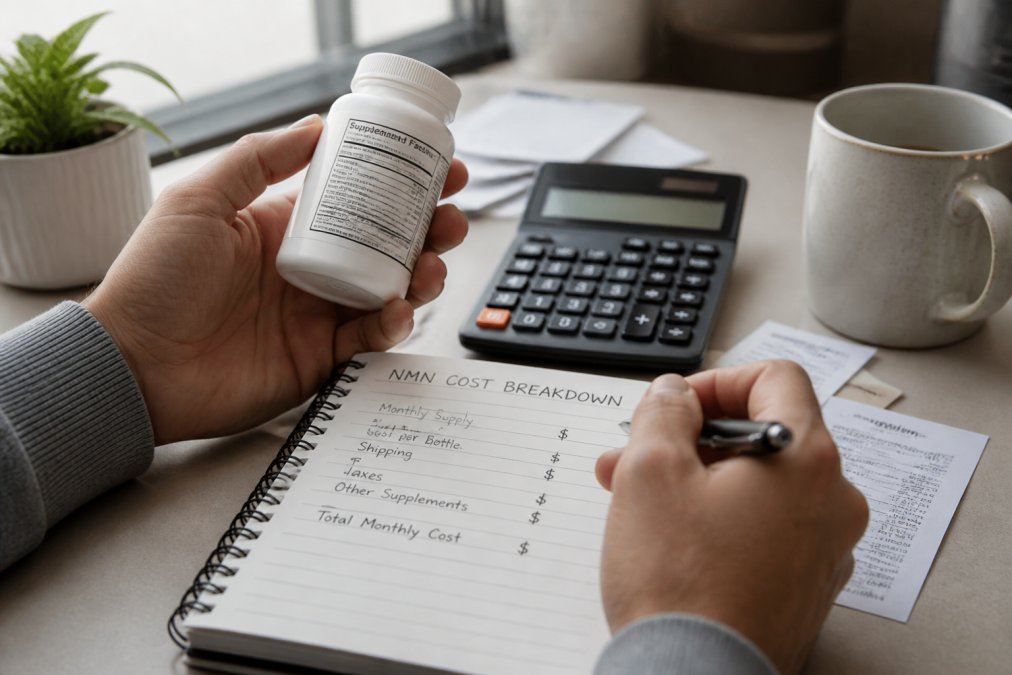
Here's the uncomfortable part most guides skip. The label price tells you almost nothing. What matters is cost per gram of actual NMN, verified by a lab, and then what that gram costs you per day at a real dose.
Cost Per Gram Breakdown for Leading Brands
A 30-gram tub at $30 and a 15-gram tub at $45 are not comparable products. Divide price by grams of NMN, not total capsule weight. Fillers, flow agents, and capsule shells add mass without adding NMN.
Worked example. Suppose a 30-gram tub of unverified powder sells for $30. That's $1.00 per gram on the label. If a third-party COA shows the material is 85% NMN, your true cost is roughly $1.18 per verified gram. Now suppose a 15-gram tub of verified NMN sells for $45.
| What You're Buying | Typical Red Flag | What It Costs You |
|---|---|---|
| Unverified bulk powder | No lot-specific COA | Unknown purity, possible heavy metals |
| Cheap capsules | "Proprietary blend" label | Underdosed NMN per serving |
| Verified, tested NMN | Higher upfront price | Known purity, stable dosing |
Why Cheap NMN Often Costs More Long-Term
Cheap NMN fails in three predictable ways. It degrades before you finish the bottle. It contains less NMN than the label claims. Or your body absorbs so little that you're paying for expensive urine.
The ROI Question Nobody Asks: NMN vs. Lifestyle Interventions
Most cost-per-gram guides stop at the price tag. The more useful question is where your next dollar does the most work for longevity.
Best NMN Supplement for Energy: What Separates Top Formulas
The best NMN supplement for energy is the one your cells can actually absorb. NMN is a large molecule, and absorption rate varies widely between formulations. Two products with identical labels can perform completely differently in the body.
Three factors separate top formulas from the rest:
- Purity: pharmaceutical-grade NMN, not industrial-grade raw material
- Delivery: enteric coating or enhanced bioavailability technology
- Testing: third-party verification of every production lot
Bioavailability and Delivery Technology
Standard NMN capsules release in the stomach, where acid degrades a portion of the dose before absorption. Enteric coating delays release until the intestine, where uptake is more efficient. This is why two products with the same milligram count can produce different results.
Rejuven8 Infinity: A Case Study in Value
Rejuven8 Infinity costs $49.99 and illustrates what the "purity premium" actually buys. The formula is manufactured in GMP-certified facilities, third-party tested for purity and potency, and optimized for maximum absorption. It supports NAD+ production, cellular energy metabolism, and mental clarity.
Ask any NMN brand for a lot-specific certificate of analysis before you buy. If they can't produce one for the exact batch you'd receive, you're buying blind.
NMN Dosage for Anti-Aging: How Much Do You Need to Feel Results?
NMN dosage for anti-aging typically ranges from 250 mg to 500 mg daily in most consumer protocols, though researchers have studied higher amounts. There is no single official dose, and individual response varies with age, metabolism, and baseline NAD+ levels.
A Practical Titration Schedule
A common pattern practitioners recommend looks like this:
- Weeks 1-2: 250 mg daily, taken at the same time each day.
- Weeks 3-4: If tolerated and you notice nothing, step to 500 mg daily.
- Weeks 5-8: Hold at 500 mg. This is where most users who respond at all report changes in energy or focus.
- Beyond week 8: Only consider higher amounts after a full two months at 500 mg, and only if you have a reason to believe absorption, not dose, isn't the limiting factor.
Splitting the dose (for example, 250 mg morning and 250 mg early afternoon) is a common approach because NAD+ levels fluctuate across the day. Taking it too late in the evening can interfere with sleep for some users.
Timing, Food, and Absorption
NMN is generally taken with or without food, but two mechanics matter more than the label suggests. First, stomach acid degrades a portion of unprotected NMN before it reaches the intestine, which is why enteric-coated or otherwise protected formulas can deliver more usable NMN per milligram. Second, taking NMN alongside a meal that contains fat and protein tends to slow gastric emptying, which can reduce acid exposure, a small but real effect.
Why the Same Dose Works for One Person and Not Another
This is the part almost no guide addresses, and it's the single biggest reason people conclude NMN "didn't work" and waste their money.
How Long Before You Feel Anything?
Most users report noticeable changes in energy or focus somewhere between two and eight weeks. If you feel nothing after a full month at a consistent dose, the problem is usually product quality or absorption, not the dose itself. If you feel nothing after eight weeks on a verified product at 500 mg, the more likely explanation is individual metabolic response, and the honest answer is that more milligrams probably won't change it.
Third-Party Tested NMN Brands: The Purity Premium That Protects Your Investment
Third-party tested NMN brands pay an outside lab to verify what's actually in the bottle. That testing covers purity percentage, heavy metal screening, and potency. It is the single most reliable quality signal in this category.
What a real COA should show
- Purity percentage of the NMN raw material
- Heavy metal panel results
- Microbial testing
- Lot number matching your bottle
Without a lot number, a certificate proves nothing about your specific purchase.
Some brands display a generic "lab tested" badge with no lot number and no downloadable report. That badge is marketing, not verification. You have no way to confirm what's in the bottle you're holding.
NMN vs. Lifestyle Interventions: Where Your Money Goes Further
NMN versus lifestyle interventions is not a fair fight, because they do different jobs. Sleep, resistance training, and protein intake build the foundation. NMN supports the NAD+ pool that declines with age. Skip the foundation and no supplement compensates.
The honest cost-benefit picture looks like this:
| Intervention | Monthly Cost | Evidence Base | Best Paired With |
|---|---|---|---|
| NMN supplement | Varies by brand | Growing, early-stage trials | Sleep and exercise |
| Resistance training | Gym or free | Strong, decades of data | Protein intake |
| Sleep optimization | Free to low | Strong | Everything else |
| Dietary changes | Varies | Strong | Consistent routine |
The 2026 Regulatory Landscape: How FDA Status Affects Price and Availability
NMN's regulatory status in the United States remains unsettled, and that uncertainty directly affects price. The FDA's position on NMN as a dietary supplement ingredient has shifted in recent years, and the agency has stated that NMN does not qualify as a lawful dietary supplement ingredient under its current interpretation. Legal challenges and industry pushback continue.
Conclusion: Making the Call on NMN's Value
The real question isn't whether NMN is expensive. It's whether you're paying for verified NMN or for a label. Cost per verified gram, third-party testing, and delivery technology separate formulas that work from powders that don't.
Frequently Asked Questions
Is NMN really worth the hype in 2026?
NMN's value depends on your goals and budget. Clinical trials show it can raise NAD+ levels, which supports cellular energy and repair, but results vary. If you're looking for a science-backed way to support healthy aging and energy, a high-purity, third-party tested NMN like Rejuven8 Infinity at $49.99 per bottle may be worth it. If you expect overnight anti-aging miracles, no supplement delivers that. Focus on purity, dosage, and realistic outcomes.
What is the average price range for high-quality NMN supplements?
High-quality NMN typically costs between $40 and $80 per bottle for a 30-day supply, depending on purity, dosage, and third-party testing. Rejuven8 Infinity is priced at $49.99, which is competitive for a pharmaceutical-grade formula. Beware of ultra-cheap options under $20; they often cut corners on purity or use fillers. Always calculate cost per gram of actual NMN, not just the bottle price.
How do I determine if an NMN supplement is worth the cost?
Check four things: third-party testing for purity and heavy metals, dosage per serving (250-500 mg is common for anti-aging), bioavailability features like enteric coating, and cost per gram. Rejuven8 Infinity offers GMP certification and enhanced absorption. If a brand can't provide a certificate of analysis, it's not worth your money. Also consider your personal response; some people feel energy improvements within weeks, others need 2-3 months.
Why did the FDA status of NMN change and how does it affect pricing?
The FDA has stated that NMN is not a legal dietary supplement ingredient in the U.S. because it was first studied as a drug. This has led to supply chain disruptions and removal from some marketplaces. As a result, prices for compliant, high-quality NMN have risen. Brands that continue to sell NMN must navigate this gray area, which often means higher costs for purity verification and legal compliance. Expect to pay a premium for reputable sources.