

Natural Alternatives to NMN Supplements 2026
Table of Contents
- Understanding NMN and Why People Seek Alternatives
- Natural Sources of NMN and NAD+ Precursors
- NAD+ Boosting Foods You Can Eat Today
- NMN vs NR: How These Precursors Compare
- Natural Ways to Increase NAD+ Beyond Supplements
- Evidence Quality and What the Research Actually Shows
- Safety Considerations and Medication Interactions
- Frequently Asked Questions
Last Updated: October 8, 2026
Understanding NMN and Why People Seek Alternatives
Nicotinamide mononucleotide, or NMN, is a popular supplement for cellular energy and healthy aging. It's a NAD+ precursor: your body converts it into NAD+, a molecule critical for cellular energy production and repair. But many people exploring natural alternatives to NMN supplements want to know what's available and whether they need a supplement at all.
We recognize that NAD+ support comes in multiple forms. Some people respond well to NMN supplementation; others prefer dietary sources, lifestyle changes, or complementary compounds.
People seek natural alternatives to NMN supplements for several reasons: cost, skepticism about whether supplements deliver real benefits, digestive sensitivity, or a preference for food-based approaches.
Natural Sources of NMN and NAD+ Precursors
Dietary sources and bioavailability considerations
NMN exists in small amounts in certain foods, though quantities are modest compared to supplement doses. Cow's milk, whey protein, some plant-based foods, beer, and wine contain measurable NMN. However, food concentrations are far lower than a single supplement dose, and bioavailability varies significantly.
Nicotinamide riboside (NR) is another NAD+ precursor found naturally in dairy, whey, and some plant sources. Both convert to NAD+ via slightly different pathways, and neither has a clear advantage based on available evidence.
The challenge with food sources alone is quantity: matching a typical NMN supplement dose through diet would require impractical amounts.
NAD+ Boosting Foods You Can Eat Today
Polyphenol-rich options and complementary ingredients
Polyphenols are plant compounds that support cellular health and may indirectly support NAD+ metabolism. Resveratrol (red wine, grapes), curcumin (turmeric), quercetin (apples, onions), and catechins (green tea) fall into this category.
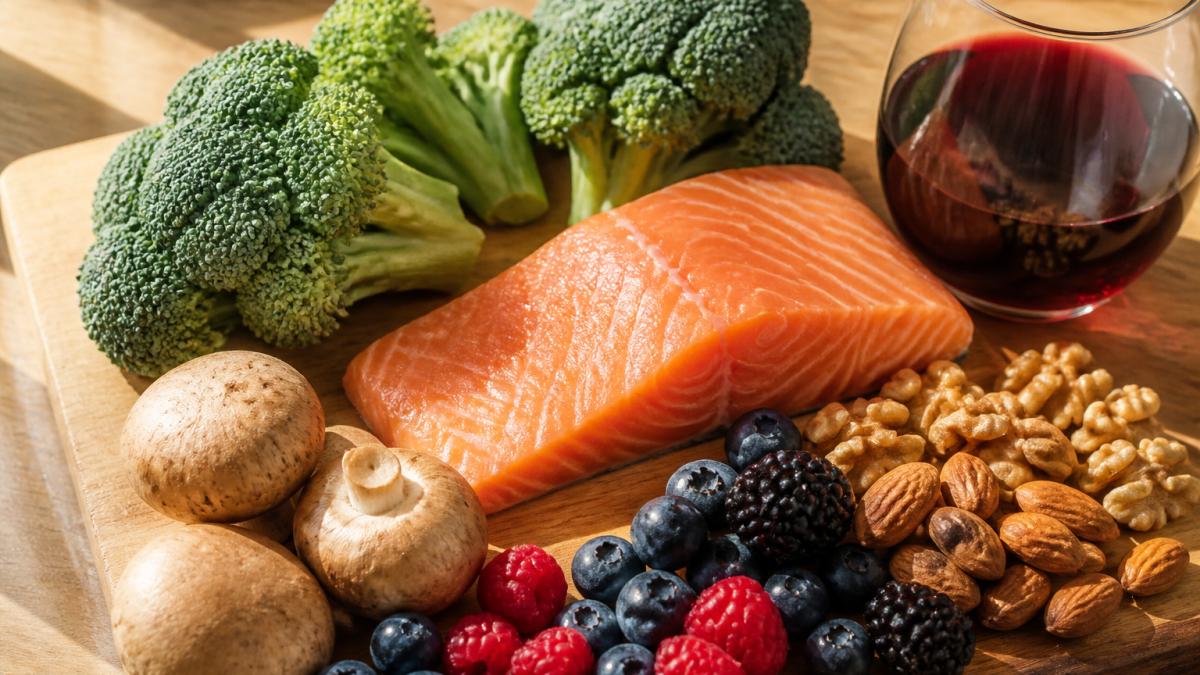
Fatty fish like salmon and mackerel provide niacin, a B vitamin your body converts to NAD+. Whole grains, mushrooms, and peanuts are also niacin sources.
CoQ10 and PQQ support mitochondrial function, where NAD+ does much of its work. CoQ10 appears in fatty fish, organ meats, and nuts; PQQ in fermented foods, green tea, and some fruits.
The practical takeaway: a diet rich in whole foods, fatty fish, colorful vegetables, nuts, and moderate polyphenol sources supports the cellular environment where NAD+ functions. It isn't a replacement for NMN supplementation if you're targeting NAD+ levels, but it's foundational.
NMN vs NR: How These Precursors Compare
NMN and nicotinamide riboside (NR) are the two most studied NAD+ precursors sold as supplements, but they aren't the only naturally occurring options. A useful comparison separates three things: conversion pathway, human dose range studied, and practical trade-offs.
The conversion pathways, step by step
- NMN (nicotinamide mononucleotide): Absorbed and converted to NAD+ through the salvage pathway. The rate-limiting enzyme is NAMPT, which converts nicotinamide to NMN, and NMN is then converted to NAD+ by NMNAT enzymes. Some evidence suggests a portion of oral NMN is converted to NR in the gut before absorption, blurring the 'direct pathway' claim.
- NR (nicotinamide riboside): Enters cells and is phosphorylated by NRK enzymes to NMN, then converted to NAD+ by the same NMNAT step. In effect, NR is one enzymatic step upstream of NMN inside the cell.
- Niacin (vitamin B3): Uses the Preiss-Handler pathway. At low doses it is efficient; at high doses it causes flushing because it binds the GPR109A receptor on skin blood vessels.
- Niacinamide (nicotinamide): Enters the salvage pathway directly as nicotinamide. It does not flush, but high doses can inhibit sirtuins and PARPs through feedback, which is why very high-dose niacinamide is not preferred.
- Tryptophan: Uses the de novo pathway (via quinolinic acid) and is inefficient, only a small fraction of dietary tryptophan ends up as NAD+. It matters for baseline maintenance, not acute elevation.
Human dose ranges studied
Most published human trials of NR have used 100-1,000 mg per day, with 300 mg and 1,000 mg most common. NMN human trials have typically used 250-1,200 mg per day, with 250 mg and 500 mg appearing most often. Niacin's tolerable upper intake level for adults is 35 mg per day from supplements. These are research doses, not clinical recommendations, no regulatory body has set an RDA for NMN or NR.
Practical trade-offs
| Factor | NMN | NR | Niacin | Niacinamide |
|---|---|---|---|---|
| Pathway | Salvage (via NMNAT) | Salvage (via NRK → NMN) | Preiss-Handler | Salvage (direct) |
| Typical studied dose | 250-1,200 mg/day | 100-1,000 mg/day | ≤35 mg/day (supplement UL) | 500-1,500 mg/day (varies) |
| Flushing | No | No | Yes, dose-dependent | No |
| Relative cost | Higher | Lower | Lowest | Low |
| Human evidence maturity | Emerging | Emerging | Established (for deficiency) | Established (for deficiency) |
What the head-to-head evidence actually shows
Direct human trials comparing NMN and NR at matched doses are scarce. What exists suggests both raise blood NAD+ dose-dependently, with the magnitude varying more by dose and baseline NAD+ status than by which precursor is used. The marketing distinction between 'direct' and 'indirect' pathways has not translated into a demonstrated outcome difference in humans.
Natural Ways to Increase NAD+ Beyond Supplements
Exercise, fasting, and lifestyle factors
Exercise is one of the most reliable ways to support NAD+ levels without supplements. Aerobic activity and resistance training both stimulate NAD+ production in muscle and other tissues, dose-dependently.
Intermittent fasting and caloric restriction trigger metabolic shifts that increase NAD+ availability. During fasting, cells activate pathways that enhance NAD+ production as part of their energy-management response.
Sleep quality directly influences NAD+ metabolism. During sleep, your body performs cellular repair and maintenance processes that depend on healthy NAD+ levels; poor sleep disrupts these and can lower NAD+ availability.
Cold exposure, through cold showers or cold environments, activates brown adipose tissue and triggers metabolic responses that increase NAD+ production. The effect is temporary but measurable, an optional tool, not a necessity.
Shop Now →
Stress reduction matters: chronic stress elevates cortisol and suppresses NAD+-dependent repair processes.
The hierarchy: exercise and sleep form the foundation; fasting and cold exposure are optional additions; supplements like NMN or natural alternatives come after you've optimized these basics.
Evidence Quality and What the Research Actually Shows
Most articles blur three different questions into one. Separating them is the most useful thing you can do before spending money on any NAD+ strategy.
Three questions, three different evidence bases
- Does the intervention raise NAD+? This is a biomarker question, the easiest to answer and best-supported. Human trials of NMN and NR consistently show dose-dependent increases in blood NAD+, typically measured as whole-blood NAD+ concentration. Exercise, fasting, and sleep optimization also shift NAD+ markers, though magnitude and durability are harder to standardize.
- Does raising NAD+ change a clinical outcome? This is where the evidence thins dramatically. Outcomes like muscle function, insulin sensitivity, cognitive performance, and inflammatory markers have been measured in a handful of small NMN and NR trials, with mixed and generally modest results.
- Does it extend healthspan or lifespan in humans? No human trial has been designed or powered to answer this. Longevity claims rest on animal models (yeast, worms, mice) and mechanistic reasoning, not the same as human evidence.
How to grade the evidence yourself
A simple hierarchy, from strongest to weakest, applied to any NAD+ claim:
- Systematic reviews and meta-analyses of randomized controlled trials in humans, strongest, but rare in this field.
- Individual randomized controlled trials in humans, the backbone of what we know about NMN and NR dosing and NAD+ elevation.
- Observational human studies, useful for associations (e.g., NAD+ declines with age), not for causation.
- Animal studies, informative for mechanism, not for human dose or outcome.
- Cell and in vitro studies, hypothesis-generating only.
- Mechanistic reasoning and testimonials, weakest; often dressed up as evidence.
When you read a claim about resveratrol, curcumin, or quercetin supporting NAD+, ask which tier it sits in. Most polyphenol-NAD+ claims sit at the cell-study or animal-study tier, with human trials measuring NAD+ as a secondary marker rather than a primary outcome.
What is genuinely well-established
- NAD+ levels decline with age in humans and animal models, consistent across multiple tissue types.
- Exercise increases NAD+ availability in skeletal muscle in humans, one of the better-supported lifestyle levers.
- NMN and NR supplements raise blood NAD+ in humans at the doses studied, replicated across multiple small trials.
- Severe niacin deficiency (pellagra) causes NAD+ depletion and is corrected by niacin repletion, textbook, not controversial.
What remains genuinely uncertain
- Whether the NAD+ increase from any supplement translates into measurable health benefits in healthy adults.
- Whether food-based polyphenols raise NAD+ enough to matter, or whether their benefits operate through NAD+-independent pathways.
- Whether long-term (multi-year) supplementation is safe and effective, since most trials run weeks to a few months.
- Whether individual baseline NAD+ status predicts who responds, an active research question, not a settled one.
Why this matters for choosing an alternative
If you accept that the outcome evidence is thin across the board, the decision shifts from 'which one works best' to 'which one has the best risk-to-cost profile for the effect I can actually measure.' That reframing makes food-and-lifestyle options competitive with supplements: lower cost and lower risk, even if their NAD+ effect is smaller and less consistent.
Safety Considerations and Medication Interactions
NMN and natural alternatives are generally well-tolerated, but safety considerations exist.
Medication interactions are possible, particularly with NMN's effects on NAD+ metabolism.
Polyphenol-rich foods and supplements can interact with certain medications, particularly blood thinners and some cancer treatments.
High-dose niacin supplementation can cause flushing and, in extreme cases, affect liver function; amounts in food are safe.
For most healthy adults, natural alternatives to NMN supplements, dietary polyphenols, niacin from food, exercise, and fasting carry minimal risk. They're also unlikely to produce the dramatic NAD+ elevation a supplement might.
| Approach | NAD+ Support Mechanism | Evidence Quality | Safety Profile | Accessibility |
|---|---|---|---|---|
| NMN supplement | Direct precursor | Moderate (limited human trials) | Generally safe, GI symptoms possible | Requires purchase |
| NR supplement | Direct precursor | Moderate (limited human trials) | Generally safe, less expensive than NMN | Requires purchase |
| Exercise | Stimulates endogenous production | Strong (well-established) | Safe for most, requires consistency | Free |
| Intermittent fasting | Activates NAD+-dependent pathways | Moderate (emerging evidence) | Safe for most, not suitable for all | Free |
| Polyphenol-rich foods | Indirect cellular support | Moderate (supporting evidence) | Safe, potential medication interactions | Widely available |
| Sleep optimization | Supports NAD+-dependent repair | Strong (foundational) | Safe | Free |
Natural alternatives to NMN supplements exist across a spectrum: from dietary sources and lifestyle changes that support NAD+ metabolism broadly, to compounds like nicotinamide riboside that function similarly to NMN.
If you're specifically targeting NAD+ elevation and want a supplement-based approach, Rejuven8 Pharmaceuticals offers a science-backed NMN formula with advanced delivery technology designed to optimize cellular absorption.
Frequently Asked Questions
What are the best natural alternatives to NMN supplements?
Natural alternatives include foods rich in NAD+ precursors like nicotinamide riboside (NR) found in whey and yeast, plus polyphenol-rich options such as resveratrol in red grapes and curcumin in turmeric. Lifestyle approaches like exercise, intermittent fasting, and adequate sleep also support NAD+ availability. However, dietary sources provide significantly lower concentrations than concentrated supplements, so effectiveness varies by individual goals and current NAD+ status.
Can foods naturally increase NAD+ levels?
Yes, certain foods support NAD+ production. Cow's milk and whey contain nicotinamide riboside (NR), a direct NAD+ precursor. Plant-based polyphenols in green tea, red wine, dark chocolate, and berries activate sirtuins and support cellular energy metabolism. While food-first approaches are accessible and safe, they deliver lower bioavailable doses than clinical supplement protocols, making them better suited as foundational support rather than sole intervention for age-related energy decline.
What is the difference between NMN and NR?
NMN (nicotinamide mononucleotide) and NR (nicotinamide riboside) are both NAD+ precursors but differ in molecular structure and pathway. Published human clinical trials show both support NAD+ restoration, though direct head-to-head comparisons remain limited. Choice depends on individual response and dosage form preference.
Are natural NMN alternatives as effective as supplements?
Natural food and lifestyle alternatives support NAD+ metabolism but typically deliver lower concentrations than standardized supplement protocols. A food-based approach works well for baseline cellular health and healthy aging support in adults without significant age-related energy decline. However, individuals experiencing substantial fatigue, cognitive fog, or seeking measurable cellular repair benefits may find concentrated doses more effective.