

NMN Powder vs Capsules: Which Absorbs Better?
Table of Contents
- NMN Powder vs Capsules: The Absorption Question
- How Each Form Delivers NMN to Your Cells
- Sublingual NMN vs Oral Capsules: Bioavailability Compared
- Liposomal NMN Benefits for Absorption
- Stability, Shelf-Life, and Storage: Powder vs Capsules
- NMN Supplement Dosage Guidelines by Form
- How to Choose the Best NMN Form for Your Routine
- Conclusion: Making the Science-Backed Choice
- Frequently Asked Questions
Last Updated: September 9, 2026
NMN Powder vs Capsules: The Absorption Question
The debate over the best NMN powder vs capsules for absorption comes down to one biological reality: NMN must reach your bloodstream intact to raise NAD+ levels, and the delivery format determines how much survives the journey. NMN is the direct precursor to NAD+, a coenzyme essential for cellular energy production and DNA repair that declines naturally with age.
The common assumption is that powder absorbs faster because it dissolves before you swallow it. That logic misses what happens after ingestion. Both forms face the same gauntlet: stomach acid, enzymatic breakdown in the gastrointestinal tract, and first-pass metabolism through the liver. The real difference lies in how each format protects the active ingredient from these barriers.
Below, we break down the science of sublingual absorption, oral delivery, liposomal encapsulation, and stability data.
How Each Form Delivers NMN to Your Cells
NMN powder is designed for flexible dosing but typically requires swallowing, which exposes the molecule to gastric acid and digestive enzymes that can degrade it before absorption. Capsules offer the same oral route with the added benefit of pre-measured doses and, in some formulations, protective coatings that shield the active ingredient from stomach acid.
When you swallow NMN, it travels through the gastrointestinal tract where absorption kinetics depend heavily on the supplement delivery system used. The metabolic pathway for NAD+ precursors is well documented: NMN converts to NAD+ inside cells, but only the fraction that survives digestion reaches systemic circulation intact.
Sublingual NMN vs Oral Capsules: Bioavailability Compared
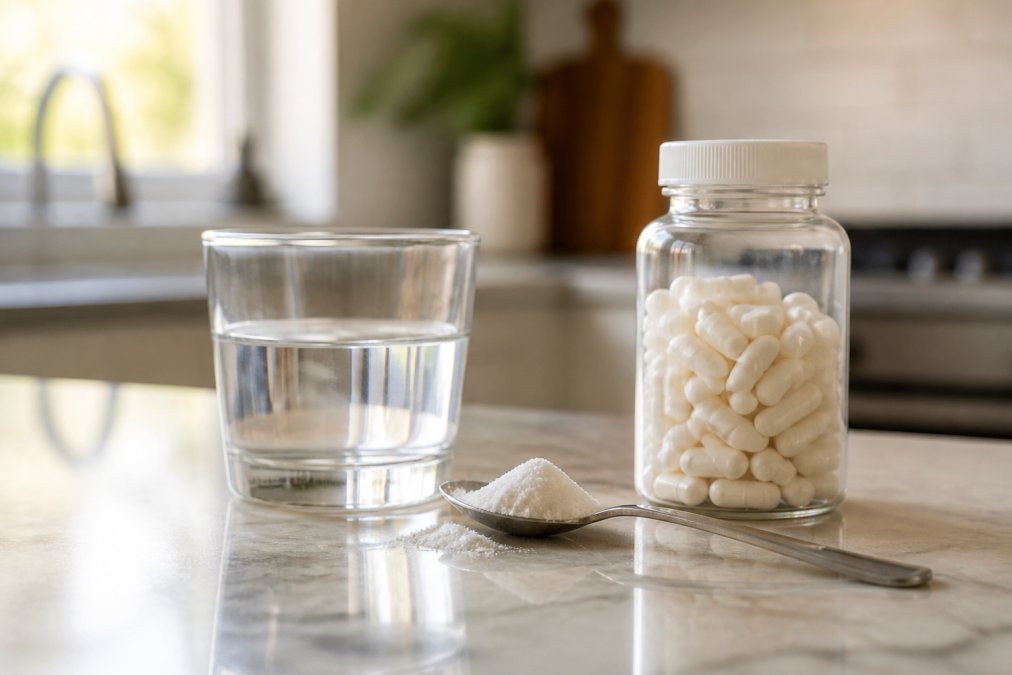
Sublingual absorption is the strongest argument for powder formats, but only when used correctly. Holding powder under the tongue for 60-90 seconds allows mucosal delivery directly into the capillary network, bypassing first-pass metabolism entirely. This route delivers NMN straight into systemic circulation, which many researchers consider the most efficient path for this molecule.
The mechanism behind sublingual delivery is straightforward but often misunderstood. The sublingual mucosa is highly vascularized, with capillaries draining directly into the internal jugular vein, bypassing the liver's first-pass metabolism where a significant portion of orally ingested NMN is deamidated to nicotinamide riboside (NR) or broken down into nicotinamide. The enzyme CD38, which degrades NMN, is highly expressed in the liver and intestinal lining, so avoiding that first pass preserves more intact NMN for cellular uptake.
The oral route is more complex than a simple 'swallow and absorb' model. When NMN enters the stomach, it encounters an acidic environment (pH 1.5-3.5) that can hydrolyze the molecule. Surviving that, NMN moves to the small intestine where ectoenzymes like CD73 and alkaline phosphatase on the brush border can dephosphorylate NMN to NR before absorption. Once absorbed, the portal circulation delivers the remnants to the liver for additional enzymatic processing.
What the research suggests about actual absorption rates: Human studies using isotopically labeled NMN show that oral administration raises plasma NMN levels, but conversion efficiency is limited. One pharmacokinetic study demonstrated that a single oral dose (100 mg, 250 mg, and 500 mg) resulted in a rapid but transient increase in plasma NMN, with peak concentrations within 15 minutes. However, a substantial portion of the dose was metabolized before reaching systemic circulation, supporting the rationale for sublingual or other bypass strategies.
The sublingual route has its own limitations. The sublingual mucosa has a limited surface area (approximately 200 cm² compared to the small intestine's 250 m²), meaning only a finite amount of NMN can be absorbed sublingually in a given time window. For doses above 250 mg, holding powder under the tongue for 60-90 seconds may not allow complete absorption, some of the dose will inevitably be swallowed.
A practical protocol for sublingual dosing:
- Use a dose of 125-250 mg for sublingual administration
- Hold the powder under the tongue without swallowing for a full 90 seconds
- Expect that a portion of higher doses will be swallowed and processed via the oral route
- Avoid eating or drinking for 10 minutes after sublingual administration to maximize mucosal contact time
Individual variability is the wildcard. Sublingual absorption efficiency varies with age, oral mucosal health, and hydration status. Older adults often have reduced mucosal blood flow, which can slow absorption. For these reasons, some practitioners recommend a hybrid approach: take a lower sublingual dose for rapid absorption and rely on a capsule formulation for the remainder of your daily target.
What this means for your choice: If you're seeking the fastest possible route to systemic circulation and are willing to manage the practical constraints of sublingual dosing, powder offers a genuine advantage. If you prefer a set-and-forget approach, capsules with enteric coatings or liposomal delivery provide a more consistent, if slower, absorption profile.
Liposomal NMN Benefits for Absorption
Liposomal delivery wraps NMN in phospholipid bilayers that protect the molecule from enzymatic breakdown in the digestive tract. This supplement delivery system mimics cell membrane structure, allowing the liposome to fuse with intestinal cells and release NMN directly inside, improving bio-efficacy compared to standard oral forms. NMN anti-aging benefits.
The liposomal NMN benefits extend beyond protection. The phospholipid shell enhances solubility and facilitates transport across the intestinal lining, potentially increasing the fraction of the dose that reaches systemic circulation. This approach addresses the core limitation of both standard powder and uncoated capsules.
| Delivery Method | Absorption Route | Key Advantage | Primary Limitation |
|---|---|---|---|
| Standard Powder | Oral / Sublingual | Flexible dosing, sublingual option | Requires discipline, acid degradation |
| Uncoated Capsules | Oral | Convenient, pre-measured | Gastric acid reduces potency |
| Enteric-Coated Capsules | Oral (intestinal) | Protects from stomach acid | Slower onset, more variables |
| Liposomal | Oral (enhanced) | High bio-efficacy, protection | Higher cost, formulation complexity |
Stability, Shelf-Life, and Storage: Powder vs Capsules
Stability differences between NMN powder vs capsules significantly impact long-term potency. NMN is susceptible to oxidative degradation and moisture, which can reduce the active ingredient's effectiveness over time. Capsules offer superior protection because the active ingredient is sealed away from environmental exposure until consumption.
The chemistry of NMN degradation is more specific than most articles acknowledge. NMN is a phosphorylated nucleotide whose stability is primarily threatened by humidity and heat. The molecule is hygroscopic, readily absorbing moisture from the air. When NMN absorbs water, it can undergo hydrolysis, breaking the phosphate bond and converting NMN into nicotinamide riboside (NR) and inorganic phosphate, reducing the amount of intact NMN available for NAD+ synthesis.
Temperature accelerates this process exponentially. According to the Arrhenius equation, the rate of chemical degradation roughly doubles for every 10°C (18°F) increase in temperature. NMN stored at 30°C (86°F) degrades approximately four times faster than NMN stored at 10°C (50°F). Stability testing shows that NMN powder stored in a warm, humid environment can lose 10-20% of its potency within 3-6 months, while the same powder stored in a cool, dry location maintains potency for 12-24 months.
Capsules provide a physical barrier that powder lacks. The capsule shell, whether gelatin or plant-based cellulose, acts as a moisture barrier, particularly important for consumers in humid climates or who store supplements in bathrooms. However, standard two-piece hard-shell capsules are not hermetically sealed; they can still allow moisture ingress over time. Blister-packed capsules offer superior protection because each dose is individually sealed.
Powder storage is a matter of exposure management. Every time you open a powder container, you introduce humid air and potential contaminants. The most effective storage protocol for powder is:
- Store in an airtight container with a desiccant packet
- Keep the container in a cool, dark place, not on a kitchen counter near the stove or in a bathroom
- Consider refrigerating powder if you live in a warm climate, but allow it to reach room temperature before opening to prevent condensation
- Use a clean, dry scoop every time; never introduce a wet spoon
The oxidation factor is often overlooked. NMN is also susceptible to oxidative degradation, particularly when exposed to light. UV radiation can generate free radicals that react with the NMN molecule, which is why most quality NMN products come in amber or opaque containers. Powder frequently exposed to light will degrade faster than powder kept in a dark cabinet.
Practical shelf-life expectations:
- Unopened NMN powder in a sealed, foil-lined pouch: 24 months from manufacture date
- Opened NMN powder stored properly with desiccant: 6-12 months
- Unopened capsule bottles: 24 months from manufacture date
- Opened capsule bottles stored in a cool, dry place: 12-18 months
- Any NMN product exposed to high heat (above 40°C/104°F) or high humidity (above 65% RH): assume accelerated degradation, regardless of form
A storage test you can do at home: If your NMN powder has clumped, changed color (from white to slightly yellow), or developed an off-odor, these are visual indicators of moisture absorption and potential degradation. Capsules that have softened, stuck together, or changed color should also be discarded. When in doubt, replace the product, the cost of a new bottle is far less than taking a degraded supplement that won't deliver the intended NAD+ boost.
NMN Supplement Dosage Guidelines by Form
Dosage accuracy is where powder and capsules diverge most practically. Capsules deliver a consistent, pre-measured amount of NMN every time, eliminating guesswork. Powder requires a scale or scoop, and even careful users can vary their dose by meaningful margins.
Typical NMN supplement dosage guidelines suggest 250-500 mg daily for general wellness support, with some protocols using higher amounts. The right dose depends on your age, health goals, and how efficiently your body absorbs the specific formulation you choose.
For powder users, a milligram-accurate scale removes the variability of scoop-based measuring. For capsule users, the dosage is fixed, simplifying daily routines and making it easier to track supplemental intake over time.
How to Choose the Best NMN Form for Your Routine
The best NMN powder vs capsules for absorption ultimately depends on your priorities: maximum absorption control versus convenience and stability. If you're willing to hold powder sublingually for 60 seconds each morning and store it carefully, powder offers the most direct route to systemic circulation.
If convenience, consistency, and long-term stability matter more, capsules are the practical choice. Look for formulations with enteric coatings or liposomal delivery to address the gastric acid problem, and always verify third-party testing for purity standards.
Rejuven8 Pharmaceuticals offers Rejuven8 Infinity, a science-backed NMN formula designed to optimize cellular health and combat the natural decline associated with aging. It is a pharmaceutical-grade formula manufactured in GMP-certified facilities that supports NAD+ production and cellular repair. FDA guidance on dietary supplement current good manufacturing practices requires that all supplements meet basic quality standards, but formulation and delivery technology determine real-world effectiveness.
Conclusion: Making the Science-Backed Choice
Both NMN powder and capsules can raise NAD+ levels, but absorption efficiency, stability, and convenience differ meaningfully. Powder wins on sublingual absorption potential; capsules win on stability, dosage accuracy, and ease of use. The science of NAD+ precursor absorption research continues to evolve, and individual variability means your results will depend on factors like gut health and consistency.
For most adults seeking a sustainable daily routine, a capsule formulation with advanced delivery technology offers the best balance of absorption support and practicality. Rejuven8 Infinity combines high-purity NMN with clinically validated formulas in a formula designed for superior absorption and cellular activation. National Institutes of Health Office of Dietary Supplements fact sheets recommends consulting a healthcare provider before starting any new supplement regimen.
Frequently Asked Questions
Is NMN powder more effective than capsules?
Effectiveness depends on the delivery system, not just the form. Plain powder and standard capsules both face first-pass metabolism and gastric acid breakdown, which reduces how much NMN reaches your bloodstream. Sublingual powder absorbs through the mucosal membranes, bypassing the digestive tract for higher bioavailability. Liposomal capsules protect NMN from enzymatic breakdown. For the best NMN powder vs capsules absorption, look for sublingual powder or liposomal technology rather than choosing based on form alone.
Does sublingual NMN powder absorb better than swallowed capsules?
Yes. Sublingual delivery places NMN under the tongue, where it absorbs directly into the systemic circulation through the mucosal lining. This bypasses the gastrointestinal tract and first-pass metabolism, leading to higher plasma levels faster. Swallowed capsules must survive gastric acid and enzymatic breakdown before absorption, which lowers overall bioavailability. If your priority is maximum absorption kinetics, sublingual NMN powder has a clear advantage over standard oral capsules.
What is the best way to take NMN for maximum bioavailability?
The best way combines a delivery system that protects NMN from degradation with one that enhances uptake. Sublingual administration offers direct mucosal delivery into the bloodstream. Liposomal encapsulation protects the active ingredient from stomach acid and improves cellular uptake. A product that uses advanced delivery technology to target absorption will outperform plain powder or basic capsules. Check for third-party testing and purity standards to ensure the active ingredient reaches your cells intact.
Are there side effects to taking NMN powder versus capsules?
Side effects are generally mild and similar across forms. Some people report stomach discomfort, nausea, or bloating with oral capsules, especially on an empty stomach. Sublingual powder may cause a tingling sensation under the tongue. Starting with a lower dose and following NMN supplement dosage guidelines helps minimize issues. If you have a sensitive stomach, liposomal capsules may be gentler because the protective coating reduces direct irritation of the gastrointestinal tract.
Choosing the right NMN delivery system is about matching the science to your lifestyle. Rejuven8 Pharmaceuticals offers a clinically validated, 3-step approach to cellular activation with advanced delivery technology for targeted absorption. Our formula supports NAD+ production to restore energy, sharpen mental focus, and promote sustained vitality. Shop Rejuven8 Infinity and experience a science-backed path to healthier aging.