

NMN Purity and Testing Standards: 2026 Guide
Table of Contents
- Why NMN Purity and Testing Standards Matter in 2026
- Enzymatic vs. Chemical Synthesis: What It Means for Purity
- How to Read a Certificate of Analysis (COA)
- FDA Dietary Supplement Labeling Requirements for NMN
- Common Impurities and Degradation Products to Watch For
- Choosing the Best NMN Supplement for Absorption
- Final Checklist for Verifying NMN Quality
- Frequently Asked Questions
Last Updated: September 5, 2026
Why NMN Purity and Testing Standards Matter in 2026
The supplement market is flooded with NMN products, yet the difference between a batch that supports cellular energy and one that delivers little more than placebo often comes down to NMN purity and testing standards 2026 buyers must now navigate. As NAD+ precursors grow in popularity, the gap between marketing claims and what is actually in the bottle has widened considerably.
Purity verification confirms a supplement contains the stated amount of nicotinamide mononucleotide and nothing else that could compromise safety or effectiveness. This matters because NMN is inherently unstable; it degrades into nicotinamide when exposed to heat, moisture, or poor manufacturing conditions. A product labeled "99% pure" at production may contain significantly less active NMN by the time it reaches your shelf.
Contaminated or degraded batches can introduce residual solvents, heavy metals, or microbial growth into your routine. Below, we'll show you exactly how to verify quality using the same criteria independent laboratories apply.
Enzymatic vs. Chemical Synthesis: What It Means for Purity
The manufacturing method determines the purity ceiling before a single test is run. Enzymatic synthesis uses biological catalysts to build NMN under mild conditions, producing fewer byproducts and a more consistent molecular structure. Chemical synthesis relies on harsh reagents that can leave behind residual solvents and require extensive purification.
Enzymatic synthesis generally yields a cleaner final product with fewer degradation products. Many manufacturers now prefer this route because it reduces the burden on downstream purification and produces a more stable crystalline structure.
How to Read a Certificate of Analysis (COA)
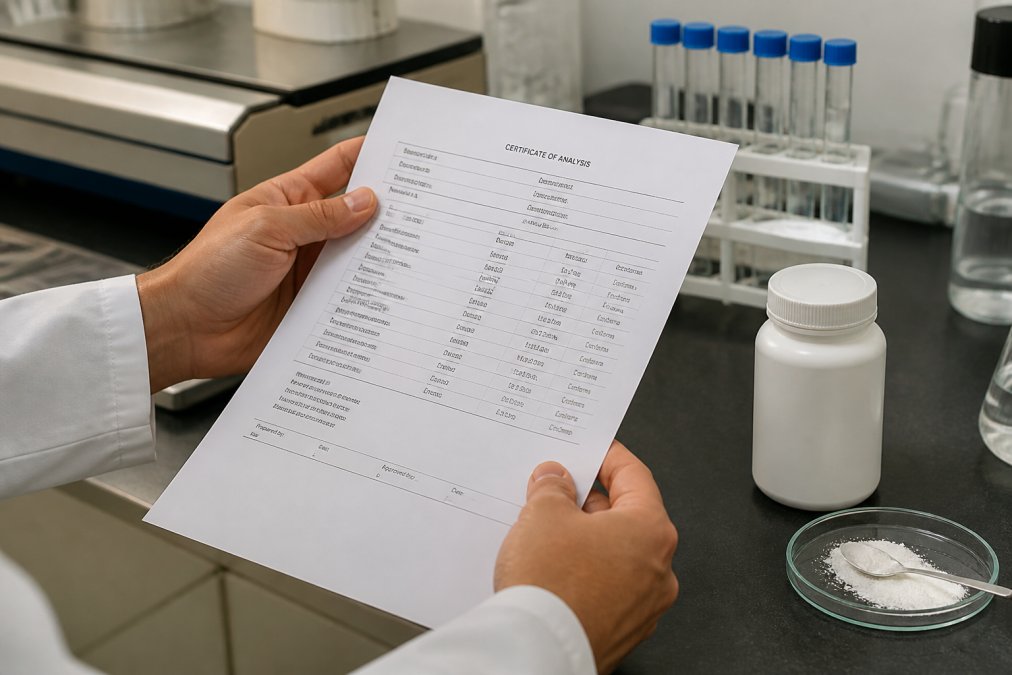
A Certificate of Analysis is the single most important document for verifying NMN quality. This laboratory report, issued by a third-party laboratory, details the exact composition of a specific batch, including purity percentage, impurity profile, and contaminant testing results. However, not all COAs are created equal, and the rise of AI-generated documents has made it easier for unscrupulous brands to fabricate reports. Verifying a COA's authenticity is just as important as reading its contents.
Step 1: Verify the Batch Number
Confirm the batch number on the report matches the batch number printed on your supplement bottle. A batch-specific COA is non-negotiable; a generic report that does not reference a specific production run tells you nothing about what you are consuming. If the batch number is missing, faded, or does not match, treat the COA as invalid.
Step 2: Check the Laboratory's Credentials
The COA should be from an independent, third-party laboratory, not an in-house lab run by the manufacturer. Look for labs that are ISO/IEC 17025 accredited, which ensures the lab has been audited for technical competence. Reputable labs include Eurofins, NSF International, and Labdoor. If the lab name is unfamiliar, search for it online to confirm it is real.
Step 3: Spotting a Fake or Doctored COA
A common pattern in the supplement industry is the reuse of an old COA for a new batch, or the alteration of a PDF to change the batch number or purity percentage. Here are key red flags to watch for:
- Inconsistent Formatting: Look for mismatched fonts, misaligned columns, or a logo that appears slightly blurry or off-color. These are signs of a doctored PDF.
- Missing Contact Information: A legitimate COA will include the lab's full address, phone number, and a direct contact for the analyst who signed the report. If this information is missing, it is a major red flag.
- Generic Signatures: A real COA will have a handwritten or digitally secure signature from the lab's quality control officer. A printed, generic signature or a signature that is identical across different batches is suspicious.
- No Methodology Details: A legitimate COA will specify the testing method used (e.g., HPLC for purity, ICP-MS for heavy metals). If the COA only lists results without any methodology, it is likely a marketing document, not a true analytical report.
Step 4: Cross-Reference with the Lab Directly
The most reliable way to verify a COA is to contact the issuing laboratory directly. Call the phone number on the report and ask to confirm they issued the document for that specific batch number. If the lab cannot confirm the report, the COA is fraudulent.
Key Sections on a COA: Purity, Solvents, and Metals
Once you have verified the COA is authentic, three sections deserve your full attention. The purity assay confirms the percentage of active NMN, with pharmaceutical-grade products typically showing 99% or higher. The residual solvents section lists any remaining processing chemicals, which should be absent or present only at trace levels. Heavy metal testing screens for lead, arsenic, cadmium, and mercury. quality testing standards.
Microbial analysis is equally important, checking for bacteria, yeast, and mold that could compromise safety. A complete COA addresses all of these categories, not just purity alone.
FDA Dietary Supplement Labeling Requirements for NMN
The FDA dietary supplement labeling requirements establish what manufacturers must disclose on product labels, though they do not require pre-market approval of supplements. Under current regulations, the FDA requires a Supplement Facts panel, an identity statement, and accurate net quantity of contents, but the agency does not verify purity claims before products reach the market.
This regulatory gap places the burden of quality assurance squarely on manufacturers and consumers. The FDA's guidance on current Good Manufacturing Practices requires supplement companies to test finished products for identity, purity, strength, and composition, but enforcement relies on inspections and post-market surveillance rather than upfront approval.
Common Impurities and Degradation Products to Watch For
While purity percentage is the headline metric, a rigorous evaluation of NMN quality requires a deeper look at the specific impurities that can compromise safety and efficacy. The most common categories are degradation products, residual solvents, and elemental contaminants.
The Primary Degradation Product: Nicotinamide
Nicotinamide (NAM) is the primary degradation product of NMN. When NMN is exposed to heat, moisture, or shifts in pH, it undergoes hydrolysis, cleaving the phosphate group and converting to nicotinamide. NAM follows a different metabolic pathway and does not directly replenish NAD+ pools in the same manner as intact NMN. A COA showing a high NAM level (typically above 2%) indicates a product that has been poorly manufactured or improperly stored, and its biological efficacy is likely compromised.
Stability Under Real-World Conditions: The 2026 Concern
The critical data point for 2026 is how a product degrades under non-ideal, real-world conditions. A common pattern in third-party testing is that a product may show 99% purity at manufacture, but after six months of storage at room temperature (which can exceed 77°F in many homes), purity can drop to 95% or lower. The degradation rate is accelerated in humid environments (above 60% relative humidity) or if the bottle is frequently opened. When reviewing a COA, look for stability data that projects purity at the end of the product's stated shelf life, not just at release. A product with a slightly lower initial purity (e.g., 98.5%) but a flat degradation curve is a better buy than one starting at 99.5% that loses potency rapidly.
Heavy Metal and Microbial Contamination Thresholds
Beyond purity and degradation, a complete safety profile must address elemental and microbial contamination. The FDA has established action levels for specific contaminants, and a responsible manufacturer will test against these limits. Key thresholds to look for on a COA include:
- Lead: Should be below 10 µg per daily serving, with many premium brands targeting less than 2 µg.
- Arsenic: Inorganic arsenic is a known carcinogen; the limit is typically set below 15 µg per daily serving.
- Cadmium: Should be below 4.5 µg per daily serving.
- Mercury: Should be below 2 µg per daily serving.
Microbial testing is equally critical. A COA should confirm the absence of harmful pathogens like Salmonella, E. coli, and Staphylococcus aureus. Total yeast and mold counts should be low (typically under 100 CFU/gram), and total aerobic microbial count should be under 1,000 CFU/gram. A COA that only lists purity and skips these safety markers is incomplete.
Residual Solvents from Chemical Synthesis
If a manufacturer uses chemical synthesis, the purification process must be robust enough to remove all residual solvents. Common solvents include methanol, acetonitrile, and ethyl acetate. The United States Pharmacopeia (USP) sets limits for these solvents based on toxicity; for example, acetonitrile is a Class 2 solvent with a permitted daily exposure limit of 4.1 mg/day. A COA should list specific residual solvent names and their measured levels, not just a blanket statement of "pass." Any residual solvent above trace levels is a red flag, as these compounds can be hepatotoxic or neurotoxic over long-term use.
Choosing the Best NMN Supplement for Absorption
Once purity is verified, absorption becomes the next consideration. The best NMN supplement for absorption combines high-purity raw material with a delivery format that protects the molecule from stomach acid and facilitates cellular uptake.
Powders offer dosage flexibility but are more susceptible to moisture degradation. Capsules provide protection from environmental factors and enable precise dosing. Advanced delivery technologies, such as those used in the Rejuven8 Pharmaceuticals formula, aim to improve bioavailability through targeted absorption mechanisms.
| Quality Factor | What to Verify | Why It Matters |
|---|---|---|
| Purity assay | 99%+ NMN on batch COA | Confirms active ingredient content |
| Synthesis method | Enzymatic preferred | Fewer impurities, cleaner profile |
| Degradation testing | Low nicotinamide levels | Indicates stability over shelf-life |
| Heavy metals | Within regulatory limits | Ensures safety for long-term use |
| Delivery format | Capsule or advanced technology | Protects potency, supports absorption |
The Rejuven8 Infinity formula combines high-purity NMN with supporting ingredients like D3, glutathione, and methylcobalamin. At $49.99, it positions itself as a premium option for those who prioritize verified quality over lowest cost.
Final Checklist for Verifying NMN Quality
Before purchasing any NMN supplement, run through this verification checklist to confirm the product meets genuine quality standards rather than marketing claims alone.
- Confirm the manufacturer uses enzymatic synthesis rather than chemical synthesis
- Request and review the batch-specific COA, not a generic lab report
- Verify the batch number on the COA matches the bottle in your hand
- Check purity assay shows 99% or higher NMN content
- Confirm residual solvents and heavy metals are within acceptable limits
- Review degradation products, particularly nicotinamide levels
- Look for manufacturing in a GMP-certified facility
- Consider the delivery format and its impact on absorption and stability
The regulatory landscape for supplements relies on manufacturer accountability rather than pre-market approval. According to the Office of Dietary Supplements at the National Institutes of Health, consumers should look for products that have been independently tested by third-party laboratories to verify content and purity.
For those who want to avoid the research burden entirely, choosing a brand that publishes its quality data transparently simplifies the decision. The USP verification program offers another layer of assurance, though participation remains voluntary for most manufacturers.
Verifying NMN quality requires more effort than reading a label, but the payoff is a supplement that actually delivers on its promise of cellular support. Rejuven8 Pharmaceuticals offers a science-backed NMN formula with high-purity ingredients designed to support NAD+ production and combat age-related decline. Get started with Rejuven8 Pharmaceuticals and experience the difference that verified quality makes.
Frequently Asked Questions
Which brand of NMN has the highest purity?
Brands that provide batch-specific Certificates of Analysis (COAs) from independent third-party laboratories are the ones you can trust for high purity. Look for a purity level of 99% or higher, confirmed by HPLC testing. The COA should also verify the absence of residual solvents, heavy metals, and microbial contaminants. A brand's own in-house testing is not sufficient; independent verification is the gold standard for confirming NMN purity.
How do I know if an NMN supplement is real?
Authentic NMN is verified through a batch-specific Certificate of Analysis (COA) from a third-party lab. This document confirms the identity and purity of the NMN molecule, typically at 99% or higher. The COA should also show tests for common impurities like nicotinamide and residual solvents. Be wary of products that do not provide this documentation, as they may contain fillers or incorrect ingredients.
What are the FDA regulations regarding NMN purity?
The FDA does not approve dietary supplements for safety or efficacy before they are sold. However, manufacturers must comply with Current Good Manufacturing Practices (cGMP) and FDA dietary supplement labeling requirements. This means they must ensure the supplement is not adulterated or misbranded. While the FDA doesn't set a specific purity level for NMN, the cGMP rules require manufacturers to verify the identity, purity, and strength of their finished products.
Why is third-party testing critical for NMN supplements?
Third-party testing is critical because it provides an unbiased, independent verification of what is actually in the bottle. A manufacturer's own quality control lab may have a conflict of interest. An independent laboratory audits the product for purity, potency, and contaminants like heavy metals and microbes. This process provides the evidence you need to confirm that the NMN supplement meets the label claims and is safe for consumption.