

Why NMN Supplements Cause Stomach Upset: Science and Solutions
Table of Contents
- What Is NMN and Why Does It Affect Your Digestive System?
- Common Gastrointestinal Side Effects of NMN Supplements
- NMN Dosage Recommendations and Tolerability
- NMN Supplement Absorption and Bioavailability Issues
- Best NMN Supplement Form for Sensitive Stomach
- How to Take NMN to Avoid Side Effects
- Managing Digestive Discomfort While Taking NMN
- Conclusion
Last Updated: August 2, 2026
What Is NMN and Why Does It Affect Your Digestive System?
Nicotinamide mononucleotide (NMN) is a nucleotide compound your cells use to produce NAD+, a coenzyme essential for energy production, DNA repair, and cellular signaling. When you take NMN as a supplement, you flood your system with a concentrated dose, triggering metabolic changes your digestive system experiences as discomfort.
How nicotinamide mononucleotide enters your body
When you swallow an NMN supplement, it must survive your gastric environment, cross the intestinal barrier, and enter systemic circulation. NMN requires specific transporters (primarily SLC12A8) in your intestinal lining to cross into the bloodstream. Taking a high dose on an empty stomach asks your intestines to absorb massive amounts of NMN in a short window. When concentration exceeds absorption capacity, excess NMN sits in your digestive tract longer than it should, triggering osmotic effects that pull water into your intestines and irritate the gastric lining.
Concentrated NMN also alters the pH environment in your stomach and small intestine, disrupting digestive enzymes and stomach acid production, leading to nausea, bloating, and gastric distress.
The metabolic changes that trigger GI distress
When NMN floods your system, your cells convert it to NAD+ at accelerated rates. This sudden increase activates sirtuins and other NAD+-dependent enzymes that regulate metabolism, inflammation, and cellular stress responses. Your digestive system responds by increasing metabolic activity, manifesting as cramping, increased motility (diarrhea), or constipation as your system recalibrates.
The rapid NAD+ shift can also trigger a mild inflammatory response in your gut microbiota. A sudden NAD+ surge shifts bacterial populations, favoring certain species over others. This dysbiosis produces gas, bloating, and abdominal discomfort that can last days.
Common Gastrointestinal Side Effects of NMN Supplements
The gastrointestinal side effects of NMN are real and measurable. They're not dangerous in most cases; they signal that the dose or timing needs adjustment.
Nausea, bloating, and abdominal pain explained
Nausea from NMN typically occurs within 15-45 minutes of ingestion and feels like mild queasiness rather than severe nausea. Concentrated NMN irritates the gastric mucosa, triggering chemoreceptors that signal your brain's vomiting center, though this rarely progresses to actual vomiting.
Bloating is the most common complaint. Unabsorbed NMN in your small intestine creates an osmotic gradient; water follows the NMN molecules, increasing intestinal volume. The altered pH environment triggers increased gas production from your microbiota as they ferment undigested NMN, creating bloating that can last 2-6 hours.
Abdominal pain or cramping is typically mild to moderate and localized to the lower abdomen. Increased intestinal motility in response to the osmotic load creates cramping sensations that usually resolve once the NMN has been absorbed or passed through your system.
Diarrhea and other digestive responses
Diarrhea from NMN is dose-dependent and often signals you've exceeded your tolerance threshold. The osmotic effect pulls water into the intestine, increasing stool volume and frequency, typically occurring 2-4 hours after ingestion and resolving within 12 hours.
Some people experience constipation, particularly if dehydrated or if their microbiota response shifts toward slower transit times. Other digestive responses include acid reflux, delayed gastric emptying, and appetite changes.
NMN Dosage Recommendations and Tolerability
The relationship between dosage and tolerability is the single most important factor in managing NMN-related stomach upset. Standard research uses doses ranging from 250 mg to 1,000 mg per day, but individual tolerance varies dramatically.
Why higher doses increase adverse effects
The dose-response relationship for NMN gastrointestinal side effects is exponential, not linear. Your intestinal transporters have a saturation point. Below that point, they efficiently absorb NMN. Above it, absorption plateaus while excess continues accumulating in your intestinal lumen. A 250 mg dose might achieve 70% absorption; a 1,000 mg dose might achieve only 40% because your transporters are overwhelmed. That means 600 mg of unabsorbed NMN sits in your gut creating osmotic stress.
Higher doses also trigger more pronounced metabolic shifts and more dramatic microbiota dysbiosis.
Finding your individual tolerance threshold
Your tolerance threshold depends on baseline metabolic rate, gut microbiota health, existing digestive conditions, and current NAD+ levels. The only way to find it is systematic dose titration, starting low and increasing gradually.
Start with 125-250 mg once daily with food. Take it for 3-5 days and observe your response. If you experience no discomfort, increase to 250-500 mg daily. Continue increasing in 250 mg increments until you find the dose that delivers benefits without triggering side effects. For most people, this threshold falls between 250-750 mg daily.
Some people tolerate higher doses if they split them throughout the day. Taking 500 mg as two 250 mg doses (morning and evening with meals) often produces less GI distress than a single 500 mg dose.
NMN Supplement Absorption and Bioavailability Issues
Poor absorption and GI distress often go hand-in-hand because the mechanisms overlap.
How gastric lining irritation reduces absorption
When NMN irritates your gastric lining, your body accelerates transit time, moving contents through your digestive system faster to minimize irritation. This is counterproductive for absorption. Your small intestine is where NMN absorption primarily occurs. If contents move through too quickly, your intestinal transporters don't have enough time to absorb the NMN molecules present.
This creates a vicious cycle: high dose → gastric irritation → accelerated transit → poor absorption → you don't feel benefits → you increase the dose further → more irritation. Many people report taking NMN for weeks without noticing energy improvements while experiencing consistent nausea because they're not absorbing enough to benefit but absorbing enough to cause discomfort.
Concentrated actives and systemic absorption challenges
The purity and formulation of your NMN supplement dramatically affects both absorption and tolerability. Many commercial NMN products contain 90-95% NMN by weight, with the remainder being fillers and anti-caking compounds.
Rejuven8 Pharmaceuticals uses advanced delivery technology that includes compounds supporting intestinal permeability, increasing the proportion of NMN that crosses into your bloodstream rather than sitting in your gut. Your body absorbs NMN through a saturable transport system. Formulations that enhance absorption efficiency allow you to achieve therapeutic NMN levels with lower total doses, meaning less GI distress.
Best NMN Supplement Form for Sensitive Stomach
If you have a sensitive stomach or have experienced GI distress from NMN, your choice of supplement form matters enormously.
Purity standards and additive analysis matter
A high-purity NMN supplement (95%+ NMN with minimal additives) is essential if you have digestive sensitivity. Some budget products contain only 70-80% NMN, with the remainder being rice flour and cellulose. These fillers ferment in your gut, producing additional gas and bloating.
Look for third-party testing certificates verifying NMN purity and absence of contaminants. Avoid products containing magnesium stearate, high amounts of silicon dioxide, artificial sweeteners like sorbitol or xylitol, and certain gums or thickeners. The best supplements for sensitive stomachs use minimal additives: NMN, a small amount of microcrystalline cellulose as a binder, and that's it. Capsules are preferable to tablets because they dissolve more predictably.
Microbiome interaction mechanisms and gut health
Your gut microbiota plays a larger role in NMN tolerability than most people realize. If your microbiome is already imbalanced, taking NMN will likely trigger more pronounced GI distress because the metabolic shift affects an already-unstable microbial community.
Before starting NMN, consider whether you have signs of dysbiosis: chronic bloating, irregular bowel movements, food sensitivities, or a history of antibiotic use. Spending 2-4 weeks supporting your microbiome health before starting NMN can dramatically improve tolerability. This means eating fermented foods (kimchi, sauerkraut, kefir), consuming prebiotic fiber (asparagus, garlic, onions), and possibly taking a high-quality probiotic.
When you start NMN, your microbiota will shift. This transition period, typically 1-3 weeks, is when you'll experience the most GI distress. Once your microbiota rebalances around the new metabolic conditions, symptoms usually resolve significantly.
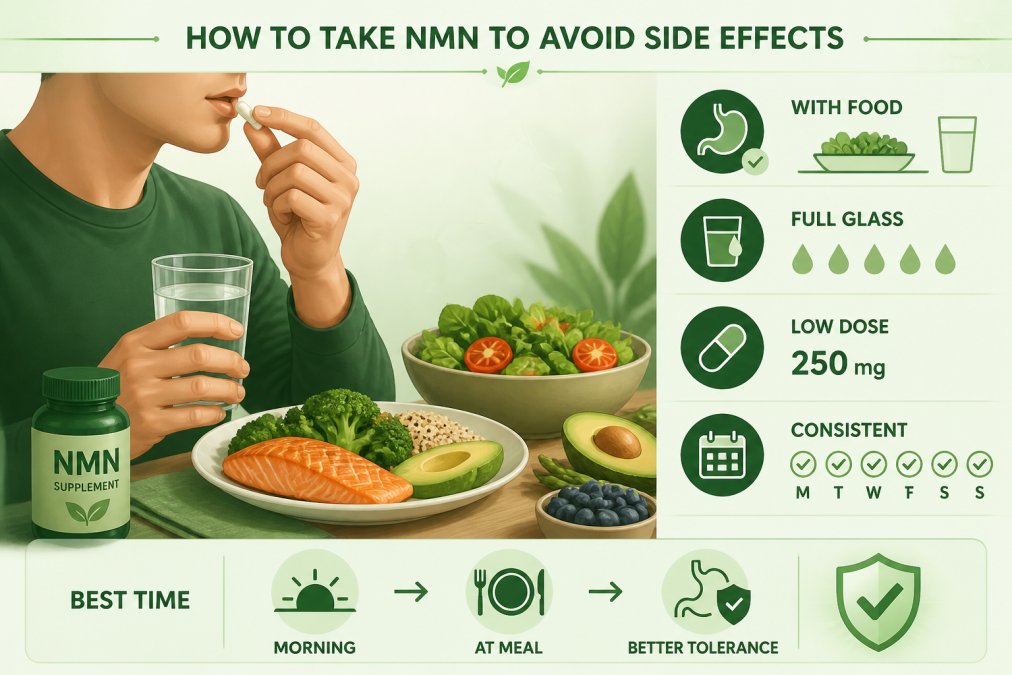
How to Take NMN to Avoid Side Effects
The protocol for taking NMN matters as much as the supplement itself. Small changes in timing, food pairing, and dose splitting can eliminate most GI distress.
Tapering protocols for gradual tolerance building
The most effective approach is dose escalation over 4-6 weeks. This allows your intestinal transporters to upregulate, your metabolism to adapt to higher NAD+ levels, and your microbiota to shift gradually.
Week 1: 125 mg once daily with breakfast Week 2: 250 mg once daily with breakfast Week 3: 250 mg twice daily (morning and evening with meals) Week 4: 375 mg twice daily Week 5: 500 mg twice daily Week 6: Assess tolerance and adjust as needed
This protocol works because each increment is small enough that your body adapts without triggering significant distress. By the time you reach 500-1,000 mg total daily intake, your system is prepared for it. Listen to your body. If you experience nausea or bloating at any dose, stay at that level for an additional week before increasing further.
Dietary pairing strategies and timing with food
Taking NMN with food is essential if you have a sensitive stomach. Food slows gastric emptying, giving your intestinal transporters more time to absorb NMN. Additionally, food buffers stomach acid, reducing direct irritation of the gastric lining.
The best foods to pair with NMN contain healthy fats and protein: eggs, avocado, nuts, and fatty fish. Avoid taking NMN with high-fiber foods (which increase gas production) or sugary foods (which feed dysbiotic bacteria).
Take NMN with your largest meal of the day, typically breakfast or lunch. Avoid taking NMN within 2 hours of other supplements or medications that affect gastric pH or intestinal motility.
| Timing Strategy | Best For | Expected Outcome |
|---|---|---|
| With breakfast, large meal | Most people, sensitive stomachs | 70-80% reduction in nausea/bloating |
| Split dose (morning + evening) | People tolerating 500+ mg | Better absorption, less peak-level distress |
| 15-20 min after eating | Severe nausea history | Maximum buffering, minimal irritation |
| With healthy fats/protein | All users | Slower transit, more absorption time |
Managing Digestive Discomfort While Taking NMN
Even with perfect protocol, some people experience GI discomfort in the first 2-4 weeks. These strategies can significantly reduce that discomfort.
Practical steps to reduce nausea and bloating
If you're experiencing nausea, try ginger. Ginger increases gastric motility, reduces inflammation in the stomach lining, and has antiemetic properties. Take 500-1,000 mg of ginger extract or fresh ginger tea 30 minutes before your NMN dose.
For bloating, peppermint is most effective. Peppermint relaxes smooth muscle in your intestines, reducing cramping and gas accumulation. Peppermint tea (1-2 cups) taken after your NMN dose can reduce bloating significantly within 30-45 minutes.
Hydration is critical. NMN creates osmotic effects in your intestines. Drink at least 2-3 liters of water daily, spread throughout the day. This dilutes the osmotic gradient and supports your kidneys in processing metabolic byproducts.
Gentle movement helps too. A 10-15 minute walk after taking NMN encourages intestinal motility and prevents bloating from building up.
If you're experiencing diarrhea, reduce your dose immediately; this signals you've exceeded your tolerance threshold. Avoid additional osmotic stress: reduce fiber intake temporarily, avoid sugar alcohols, and avoid caffeine. Once diarrhea resolves, resume your previous dose or drop back one increment and escalate more slowly.
When to consult a doctor about persistent symptoms
Most NMN-related GI distress resolves within 2-4 weeks as your body adapts. If you're experiencing persistent symptoms beyond this window despite dose reduction and proper protocol, consult a healthcare provider.
Additionally, seek medical advice if you experience severe abdominal pain, bloody stools, persistent vomiting, worsening symptoms despite dose reduction, or if you have a history of gastrointestinal conditions (IBS, Crohn's, ulcerative colitis) that NMN triggers significantly.
Some people have genetic variations in the SLC12A8 transporter that make NMN absorption inherently inefficient, leading to persistent GI distress regardless of dose. If you've followed proper protocol for 6-8 weeks without improvement, genetic testing or a trial of alternative NAD+ precursors might be worthwhile.
Understanding why NMN supplements cause stomach upset gives you the tools to prevent it. The discomfort isn't inevitable; it's a predictable response to dose, timing, and formulation that you can control through systematic protocol adjustments. By starting with a low dose, taking NMN with food, supporting your microbiome health, and escalating gradually, you can reach therapeutic NMN levels with minimal digestive disruption. Research on NMN absorption and bioavailability confirms that tolerability improves dramatically when users follow evidence-based dosing protocols. Start your cellular rejuvenation journey with the right approach, and you'll experience the energy and mental clarity benefits NMN delivers without weeks of digestive compromise.
Frequently Asked Questions
What causes stomach upset when taking NMN supplements?
NMN supplements trigger gastrointestinal distress through several mechanisms. When nicotinamide mononucleotide enters your system, it initiates metabolic changes that increase NAD+ biosynthesis. This rapid metabolic shift can irritate the gastric lining, particularly on an empty stomach. Additionally, concentrated actives in NMN formulas may overwhelm your digestive enzymes, causing nausea, bloating, and abdominal pain. The severity depends on dosage, purity standards, and individual gut microbiota composition. Starting with lower doses and taking NMN with food significantly reduces these adverse effects.
How does NMN dosage affect stomach upset and tolerability?
Dosage titration is critical for managing NMN side effects. Higher doses deliver more concentrated actives to your digestive system, increasing the risk of gastric lining irritation and inflammatory response. Clinical research suggests that most users tolerate 250-500 mg daily better than 1000+ mg doses. Begin with a lower dose (125-250 mg) and gradually increase over 2-4 weeks as your body adapts. This tapering protocol allows your digestive enzymes and gut microbiota to adjust, significantly improving tolerability. Monitor your individual response carefully, as recommended daily intake varies based on age, metabolism, and existing GI sensitivity.
Should I take NMN with food, and does it matter what kind?
Taking NMN with food substantially reduces gastrointestinal distress. Food slows gastric emptying, allowing more gradual absorption and reducing concentrated actives' impact on your stomach lining. Pair NMN with meals containing healthy fats and protein, which further buffer stomach acid and support bioavailability. Avoid taking NMN with high-fiber foods immediately before or after, as this can increase bloating. Consistent dietary pairing strategies, such as taking NMN with breakfast or lunch rather than on an empty stomach, help your body maintain steady systemic absorption and minimize nausea, abdominal pain, and diarrhea.
When should I see a doctor about NMN supplement side effects?
Consult a healthcare provider if you experience severe or persistent gastrointestinal distress lasting more than 2-3 weeks despite dosage reduction and dietary adjustments. Seek immediate medical attention if you develop signs of hyperglycemia, hyperuricemia, or severe inflammatory response. Inform your doctor of any contraindications with existing medications or conditions, especially if you have a history of sensitive stomach or inflammatory bowel conditions. A doctor can assess whether your symptoms reflect normal tolerability issues or indicate an adverse reaction requiring discontinuation. They can also verify that your NMN's purity standards and additive composition aren't triggering unexpected responses.